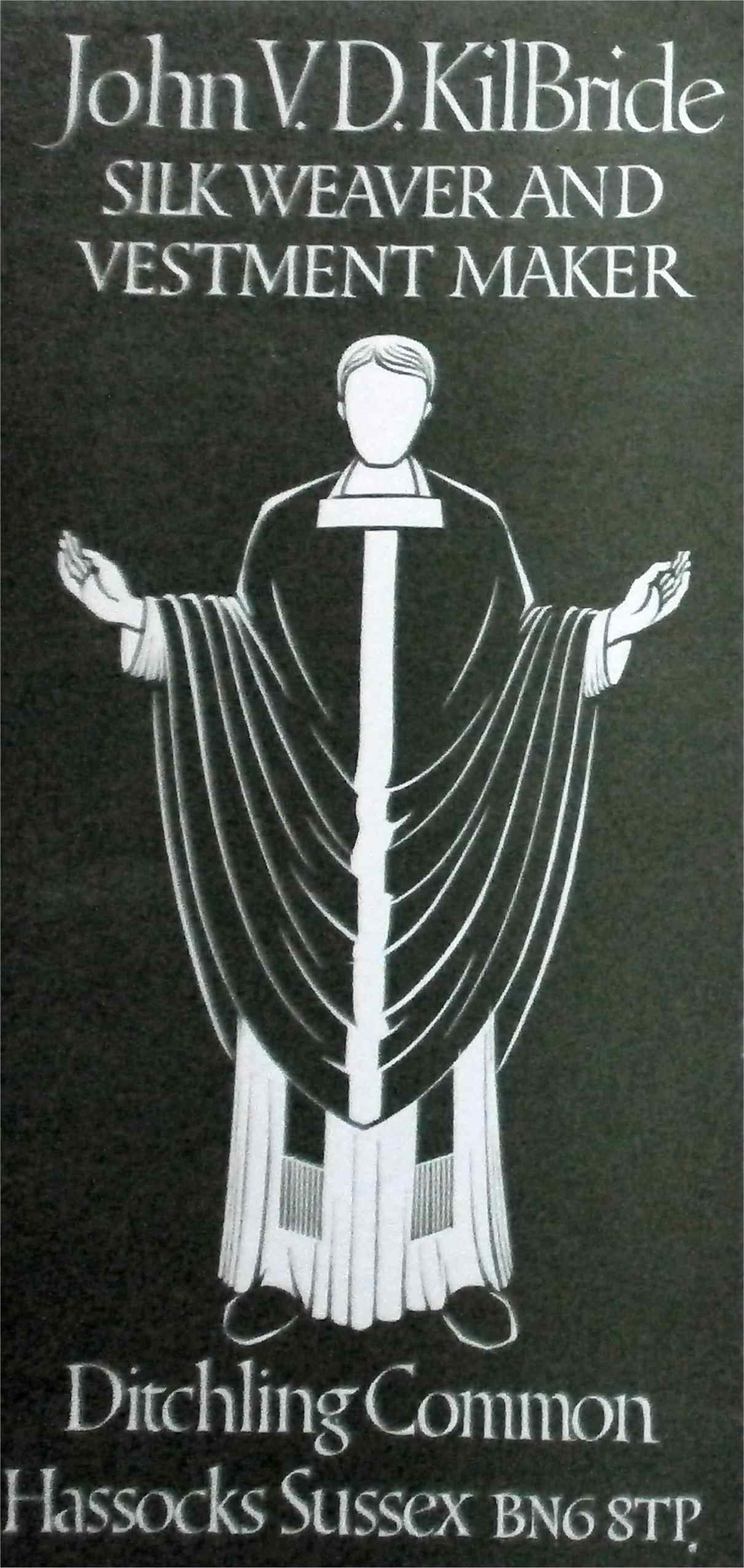
 Advertising pamphlet
Modern Materials for the traditional Vestments
The qualities aimed at for the cloth are that it should be pliable, yielding readily to folds, heavy enough to hang without clinging and of a matt rather than a lustre surface. The threads used are spun silk and Egyptian cotton which make a very durable textile. The cloth is hand-woven, from threads of a size to show the texture
of the weave; it is 60 inches wide, a very economical width for cutting out, saving many joins and waste. The price per yard must be realised in terms of this extra
width.
The weavers also do the dyeing, using Vat dyes, the fastest group of dyestuffs. The weaving is generally such as makes an over-all textured surface, but figured
included, are included, of a type that does not obscure the visible texture of the cloth. The liturgical colours are produced in many shades and the stocking of a limited range is not attempted; instead, shades of a greater variety follow in turn and are not all in stock at one time; their sequence is largely controlled by orders.
The cloth thus produced is very suitable for the full vestments which have now superseded the flat abbreviated type. It is expected that the material will be used un-lined and the vestments we make from them ourselves have no lining. The cloth has a smooth under-side, is quite heavy enough not to require lining to give extra weight, and hangs the more freely without.
The chasubles we normally make are of the classical shape, like copes sewn up the front but shortened a little on the arms. This is the original chasuble shape which
was cut down in the 16th century to make the, so-called, Roman chasuble, and now that a more ample and dignified garment is in demand the straightforward action would seem to be to restore the cloth cut away and so reproduce the original. The motive for abbreviating the chasuble in the first place was to make it more suitable for carrying heavy and elaborate ornamentation rather than to make it easier to wear.
Nobody hankers after heavy and elaborate ornamentation nowadays but some may think the classical shape difficult. It Is not our experience that this belief is justified; The chasubles has its own manner of wear of course and is not so easy if just thrown on without adjustment, but the sides should be drawn up the arms towards the elbows
and the front thus raised a little. This gives the folds so characteristic of any representation of a vested priest in the centuries before the Reformation. They are beautiful but were not designed to be beautiful, they just arise out of a true functionalism of use, of wearing a garment in exactly the right way for its shape, However we are not so dedicated to the classical chasuble as to make no other, from time to time we supply a chasuble of the circular or oval shape which enjoys scare popularity at present.
We make also the other liturgical vestments, copes with or without hoods, and dalmatics which hang in loose flowing lines, both very light and comfortable to wear. Our own woven braids are used for decoration and are available for sale for similar use by other's. We are glad to send samples of sills, braids, photos of vestments, with price quotations, to anyone interested and to submit schemes for their special needs.
John V. D. Kilbride and Joanna Kilbride