Until 1936 Pepler continued his work with St. Dominic's Press; later he devoted himself to drama, as an author of mimes and an accomplished puppeteer. His mimed stations of the cross were performed in St. Paul, Minn., Santa Fe, N.M., and Pittsburgh, Penn.; his The Field Is Won, a mime of the life of St. Thomas More, was produced at a London theatre for celebrations of the canonizations of St. Thomas and St. John Fisher; he produced mimed versions of well-known plays for the BBC; and he took puppets from his own theatre to the international marionette show in Liége in 1930.
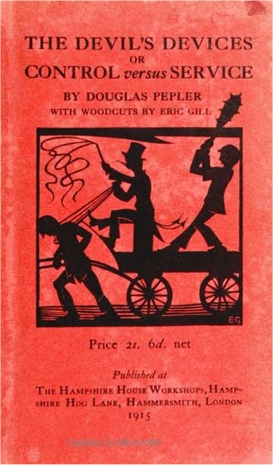
His other works include Plays for Puppets (1928), Pilate: A Passion Play (1928), In Petra (1923), Concerning Dragons (1921), Bethlehem: A Tableau of the Nativity for Presentation to Children (1927) and The Three Wise Men: A Nativity Play (1927). Upon Chesterton's 1936 death, he secured directorship and co-editorship, with Reginald Jebb (Belloc's son-in-law), of the Weekly Review (published thenceforth by the Ditchling Press, successor to St. Dominic's and managed by Pepler's son Mark and Michael Sewell), in all but name the successor to G.K.'s Weekly, organ of the Distributist League, which Pepler supported in the '30s as its honorary secretary. When the Weekly Review came to an end in 1949, Pepler established a small journal, The Register, which he published until his death. Others of his works of commentary and social and art criticism are The Hand Press and Pertinent and Impertinent. Towards the end of his life, he wrote the invaluable A Letter from Sussex: About My Friend Eric Gill (1950), giving an insider's view of what it was like to work with the talented, if difficult, artist. Pepler's last public activity was his production of his mime, The Passion of Our Lord, performed in London, at Albert Hall. Following Pepler's death, his requiem was offered in the guild chapel at Ditchling, and he was buried there in the ancient parish churchyard, near his son, David. Stanley B. James wrote of Pepler's writing that its "austere beauty" cannot be denied. "It is entirely free, he continued, "from superfluous ornament and sentimentalism. The intellectual quality is high; the lines are packed almost too closely with thought." Hilary Pepler Obituary Catholic Herald. 28th September 1951 By Douglas Hyde There was no mass-produced coffin for Hilary Pepler, who was buried in the grounds of the parish church at Ditchling, Sussex, last Monday, for H. D. C. P. hated all such things. Instead, the coffin which was borne across the two miles of Ditchling Common, from a little chapel among the workshops to the old village church, had been made by members of the com munity of craftsmen of which, with Eric Gill, he was the co-founder. And this was as it should be, for there was nothing mass-produced about H.D.C.P. either. All his life this kindly craftsman, poet, writer, dramatist and social reformer had been in revolt against the sham and shoddy. Hilary Pepler had died suddenly at the age of 73 at his home last Thursday so suddenly that the local inn-keeper told me how he had lunched there with some of his grandchildren only last Tuesday. "And we were hoping he'd be along here again tomorrow, too." In the chapel of the Guild of SS. Joseph and Dominic (the "Ditchling community") his son, Fr. Conrad Pepler, O.P., celebrated the Requiem Mass. Among those assisting were the Prior of Blackfriars, Oxford, Fr. Wykeham George, O.P., on behalf of the Dominican Order, Fr. Reginald Ginns, 0.P., and Fr. V. Maxweh, son of a member of the Ditchling Community. Man of Faith Said Fr. Wykeham George: " He was a man of faith and principle, resolute to the point of courage. The printer, the writer, the dramatist, these arts were to him ways of cooperating with the work of God." As the coffin was brought to the chapel door, a bearded member of the community of craftsmen-smallholders tolled the workshop bell, which for them marked not only the passing of Hilary Pepler but the closing of one chapter in a brave story' of experiment and vision. which still continues. In the days when he was still a Quaker, Pepler had founded a club for working men, and a cooperative group of workshops, of which his own printing and publishing office was a part. As a Quaker, too, he went with his friend Eric Gill, at the invitation of Fr. Vincent McNabb, to talk to the Dominicans at Hawkesyard Priory, but a disputation which began in the priory was vigorously continued as he walked with Fr. Austin Barker. 0.P., across the fields. At last, as they stood arguing at a stile, Pepler confessed that he had not a shot left to fire. "'When does my instruction begin 7" he asked. Fr. Vincent McNabb, O.P., at once undertook the task and was associated with his work from then on. He became a Dominican tertiary, and dedicated his press. which he had moved to Ditchling, to St. Dominic. G .K. 's WEEKLY' With Gill doing the woodcuts and Pepler printing by hand on handmade paper, the Press made a notable contribution to the typographical revival. He wrote for the New Witness, later managed G.K.'s Weekly, and continued to give a great deal of his time to The Weekly Review, which succeeded it. His interest in mime, on which he became an authority, dated from when as a very young man he was associated with William Morris. the artist-craftsman. The mimed part of the Grail's great Passion Play at the Royal Albert Hall last Maundy Thursday was his and. at seventy-two, he was considering an invitation to organise a great open-air theatre in Ceylon. He leaves a widow, who followed him into the Church, two sons and three daughters.Return to first page Back