Noted Catholic wood engraver, illustrator, artist, and social critic. Hagreen studied as a painter in Cornwall and London.
After trying a number of trades after World War I, he discovered wood engraving, and became, in 1920, a founding member of
the Society of Wood Engravers.
By 1922 he had moved to Ditchling and was learning letter cutting. He followed Eric Gill and his family to Capel-y-ffin,
but stayed only for 18 months. He returned to Ditchling by 1932 and became a member of the Guild of St. Joseph and St.
Dominic there, which had been founded by Eric Gill and H. D. C. Pepler.
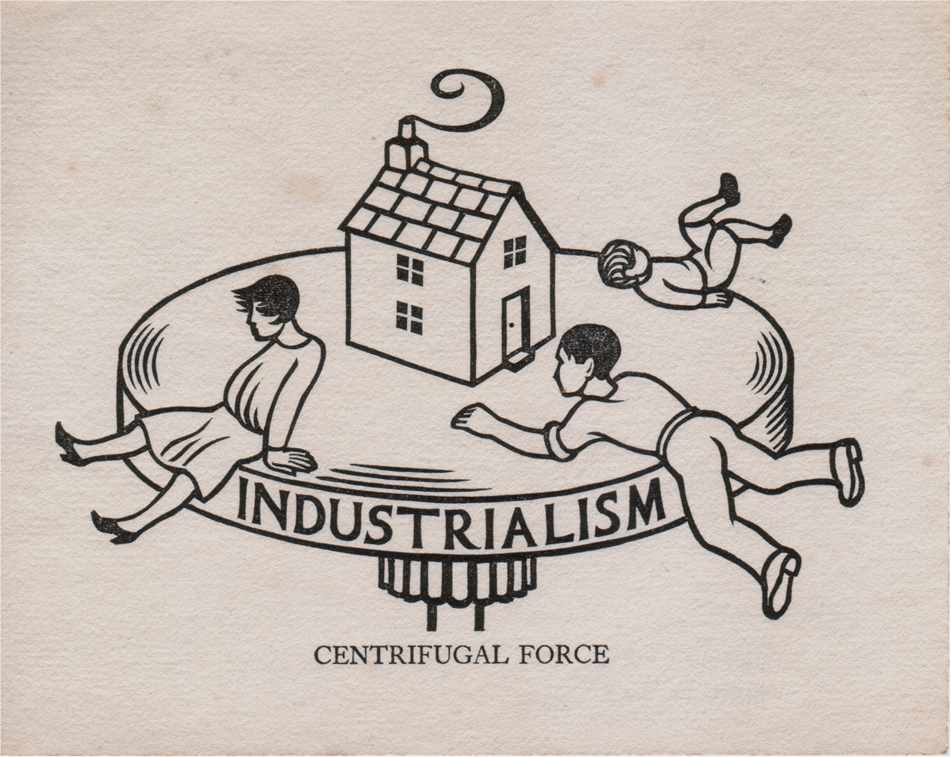
He focused thereafter on lettering, wood engraving, and satirical cartoons. He considered himself in debt to Eric Gill
for "showing him the way," and remained active with the Ditchling community until being forced to retire by poor health
in 1957. He produced most of his work to order, and no editions of his prints were made during his lifetime.
Hagreen's work was very wide-ranging, ranging from such small items as the bookplate for the "Eric Gill Collection"
of his friend, George Bernard Shaw, to the illustrations used in the literary series, The Best Poems Of, published in
1922, 1923 and 1924, and selected by Thomas Moult.
Other Hagreen illustrations appeared in William Adlington's The Golden Ass of Lucius Apuleius (1924), René Le Sage's
The Devil on Two Sticks (1927), W.A. Woodward's The Countryman's Jewel (1934), Lady Strachey's Nursery Lyrics and Other
Verses for Children (1922) and Fr. Casimir Kucharek's The Byzantine Slav Liturgy of St. John Chrysostom (1974). In 1933,
he illustrated and introduced Silversmithing: Its Principles and Practice in Small Workshops, by fellow Guild member,
Dunstan Pruden. Still more of his work can be found in The Devil on Two Sticks, Meditations on Our Lady, Apostles'
Calendar, and The Countryman's Jewel: Days in the Life of a Sixteenth Century Squire; collections of his work include
Philip Hagreen: The Artist and His Work and The Ex-Libris of Philip Hagreen, among other places.
Hagreen was also a pithy and penetrating writer, who contributed regularly to The Cross and the Plough, the journal of
the English Catholic Land Movement, edited by Harold Robbins from 1934 to 1946. He also wrote frequently for The Sign.
Towards the end of his rather long life, he wrote The Artist and His Work (1975), where he sought to sum up his artistic
experiences. Following his death, his reputation faded, but it is wonderful to note that a new appreciation of his work
has arisen in recent years with the publication of Lottie Hoare's Philip Hagreen: Sceptic and Craftsman.